Endodontics (root canal treatment)
Saving badly damaged teeth. Root canal treatment under a dental microscope.
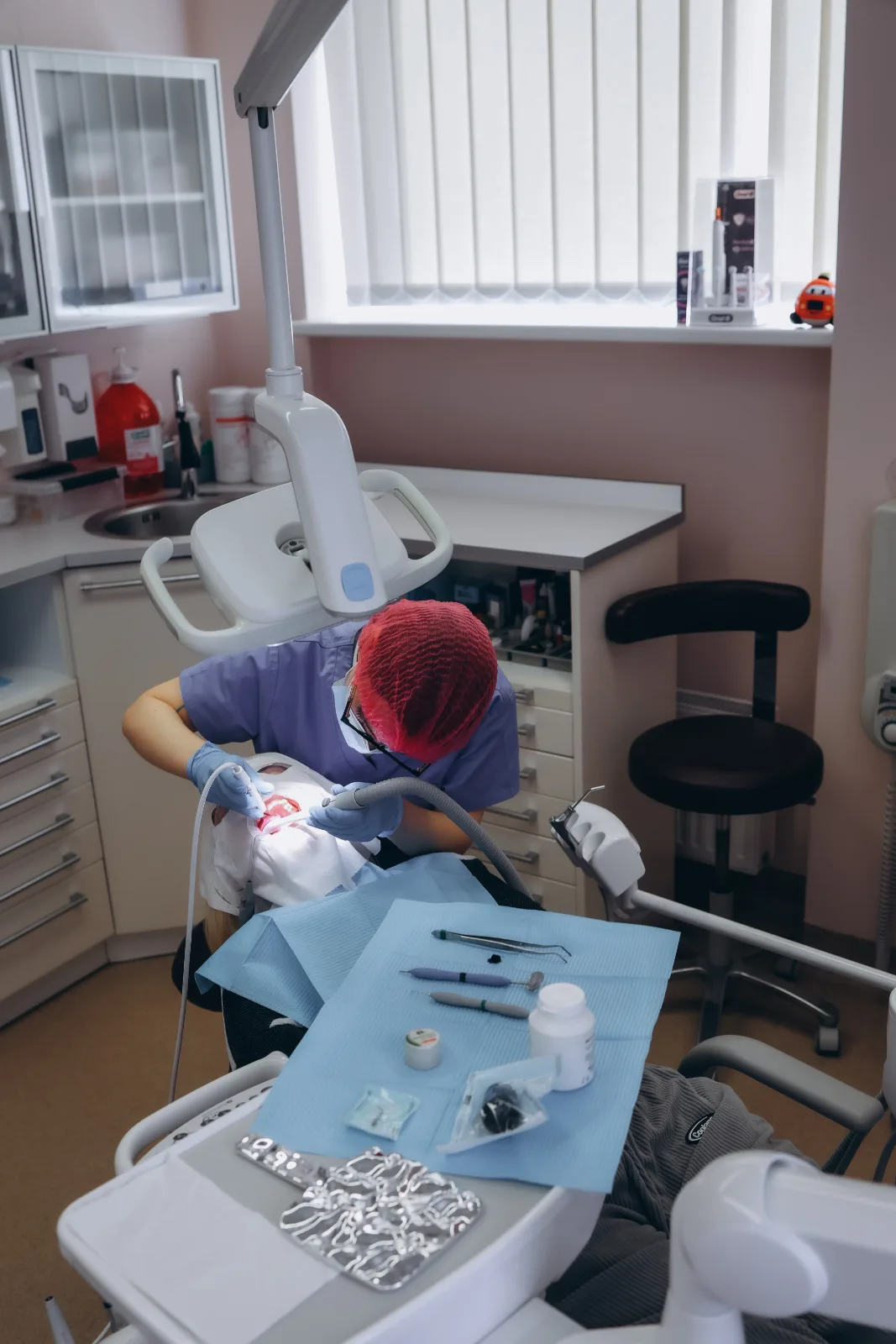
About the treatment
Root canal treatment under a dental microscope saves even the most hopeless, badly damaged teeth and prevents extraction.
The operating microscope gives 30× magnification, letting the dentist see the complex anatomy of the canals in detail, find hidden microcracks and remove every trace of infected pulp.
The canals are flushed thoroughly with ultrasound and sealed with warmed gutta-percha under X-ray control. This removes 98% of the risk of repeat inflammation and cysts.
What the visit includes
- Treatment under a microscope
- Precise 3D canal shaping
- Saving a hopeless tooth
- X-ray check at every stage
When this procedure is needed
- The tooth aches at night or reacts to heat for more than a few seconds.
- Caries has reached the nerve and a filling alone is no longer enough.
- An X-ray shows a dark area at the root tip — a focus of inflammation.
- The gum next to the tooth is swollen or a sinus tract has appeared.
- The tooth darkened after an injury.
- The canals were treated before but the pain is back — retreatment is needed.
How the visit goes
- 1X-ray and anaesthesiaA targeted X-ray or a small CT scan shows the dentist how many canals there are and what shape they take. The tooth is fully numbed — the treatment is painless.
- 2Rubber dam isolationThe tooth is separated by a latex or vinyl sheet. Saliva cannot reach the canal — the main condition for treatment that does not have to be redone a year later.
- 3Working under the microscopeThe microscope magnifies up to 25×. The dentist sees the canal openings, including the extra ones that are missed by the naked eye.
- 4Filling the canalsThe canals are filled with gutta-percha up to the root tip and a control X-ray is taken.
- 5Rebuilding the toothThe tooth is closed with a filling, or with an inlay or crown if the damage is extensive: without its walls it will split under load.
Prices for this service
- Preparing the tooth for root canal treatmentfrom 65 €
- Pulp devitalisation with a temporary filling68 €
- Extirpation of one canalfrom 65 €
- Initial canal cleaning in periodontitisfrom 82 €
- Interim session50 – 80 €
- Filling of one canal69 – 101 €
- Partial treatment of an obstructed canalfrom 44 €
- Canal retreatment: paste or gutta-perchafrom 79 €
- Canal retreatment: cement or postfrom 132 €
After the procedure
- Do not eat while the anaesthesia holds: it is easy to bite your cheek or tongue.
- A dull ache when biting during the first days is normal and passes by itself.
- Do not chew on the treated tooth while a temporary filling is in place.
- If the pain rises sharply or swelling appears, contact the clinic — do not wait for the scheduled visit.
- A tooth without a nerve is more brittle than a living one. If the damage is extensive, a crown must be placed — it protects the tooth from splitting.
Frequently asked questions
How many visits does it take?
Usually one or two. If there is inflammation at the root tip, medication is placed in the canal first — then it is three.
Why does the tooth ache after root canal treatment?
The ligaments around the root react to the work done inside the tooth. A dull ache when biting during the first days is normal and passes by itself.
Do I have to have a crown afterwards?
If more than half the tooth is gone, yes. Without a nerve and without its walls the tooth splits under load, and then there is nothing left to save.
Why is the nerve removed, and will the tooth be dead?
The nerve is removed once inflammation has reached it: it will not recover on its own, and the pain and infection would travel on into the bone. The tooth is not dead afterwards — it is held in the jaw by its ligament and works as before, but it becomes more brittle because it no longer receives nourishment from inside. That is why such teeth are usually covered with a crown.
How does pulpitis differ from caries?
By depth. Caries destroys the hard tissue, and at that stage a filling is enough. Pulpitis is when the infection has reached the nerve inside the tooth: an aching pain appears, often at night, worse from heat and easing from cold. A filling will no longer do; the canal has to be cleaned.